

 Android & iPhone
Eleven coupons were fined: where is the line of compliance against money-laundering?

Shaw Quilawyer
Just now
In September, the Central Bank centralized two administrative penalties, with a total of 1,558,000 yuan in fines for warnings and fines on both State-invested securities and Eastern wealth instruments. Of this amount, securities deposited by the State are fined $8.18 million for failing to comply with the requirements of customer due diligence, not reporting suspicious transactions as required, not conducting a money-laundering risk assessment as required, or developing an appropriate risk management system; Eastern wealth securities are subject to a fine of $740,000 for failing to comply with the requirements for customer due diligence and not reporting suspicious transactions as required.
According to incomplete public information, the central bank system imposed administrative penalties for money-laundering only on two vouchers throughout 2025; As of September 2026, the number of tickets issued during the year had reached 11, and institutional fines totalled approximately $10.6 million. In terms of the full range of tickets, the two most frequent types of violations are those in which customer due diligence is not carried out and suspicious transactions are not reported as required. Some agencies also expose deep-seated problems with money-laundering risk assessment, top control design gaps in anti-money-laundering. At the same time, double penalties for “agency + duty bearers” have gradually become normal and in cases such as Jianghai securities, persons responsible for operations and compliance receive simultaneous individual fines.
Given current trends, future anti-money-laundering controls in the securities sector will continue to tighten, and small and medium-sized dealers outside their head are likely to be under pressure. It is therefore necessary to focus on industry compliance from existing penalties.
Priorities for compliance review revealed by the disclosure of penalties
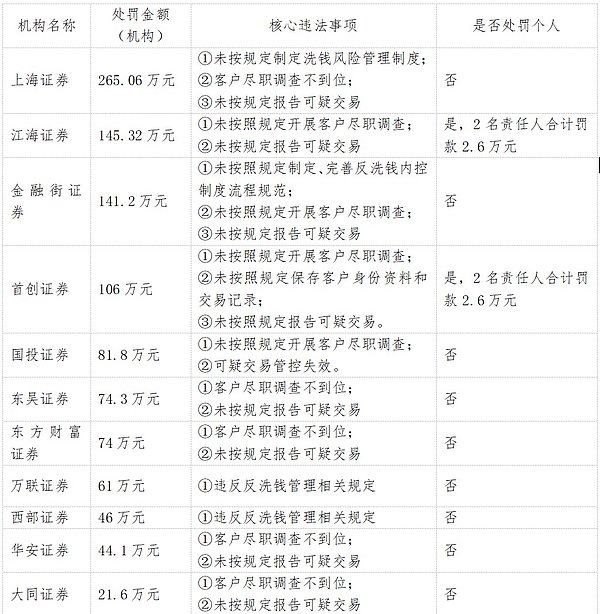
Table: Fee statistics for coupons up to September 2026
Statistics show that the vast majority of tickets are based on two basic obligations, failure to comply with customer due diligence requirements, failure to report suspicious transactions as required, and approximately one third of cases being added to category III issues, lack of risk assessment for money-laundering and inadequate controls in countering money-laundering.
II. PRACTICAL REVISION FOR VALUTORS
Customer due diligence: farewell to “opening and closing” and translation of penetrating recognition and continuous identification
Many tickets reflect the fact that a large number of institutional irregularities are focused on customer due diligence. Although the penalty decision does not disclose details of internal irregularities in individual cases, in such a intensive context of punishment, the traditional practice of uploading opening documents and automatically comparing systems with due diligence in lieu of full-process clients is no longer sufficient to meet today's “risk-based” compliance requirements. The opening of an account verification is only the starting point, and due diligence runs throughout the life cycle of the business relationship, which is also the first magnifying glass to supervise on-site inspections. The modifications can be driven by two main segments: new account openings, and stock customers.
First, the beneficial owners of non-natural person clients are identified through them and have no incentive to simply copy the results of an external platform. For the opening of accounts by a partnership, private equity fund, various types of management products etc., the central requirement for regulation is not just to obtain an operating licence but rather that the issuer needs independent verification and does not directly complete the beneficiary ' s determination by replicating the results of a business search or a public query from a third-party platform. In practice, original materials such as charters, partnership agreements, shareholders ' registers, voting rights arrangements should be collected, which would go down the three-tiered standard of 25 per cent equity, right to proceeds and effective control; Where the subject of equity and income control criteria is not found, the actual manager should be identified as beneficial owner.
In the case of non-natural person clients in stock, they are dealt with step by step at the time of supervision. Priority is given to the re-identification of clients above high risk and the verification of all customer holdings in batches; Long-term inactive accounts with transaction restrictions can be delayed until the client is reactivated to identify them and avoid inefficient resource consumption. In the case of high-risk clients who cannot stop basic information gathering, enhanced due diligence is required to further verify business background, funding sources and clearance by senior management for major transactions.
Second, the continuous identification and trigger re-identification of clients on a physical basis. She reminds that it is not the institutional customer who needs to be re-identified, and that this requirement applies also to customers of high-risk natural persons.
Thirdly, it is accompanied by the retention of information. The full set of redacted materials, verification of communication records and enhanced access to supporting documentation requires complete archiving and preservation, and when supervisory inspections are carried out, “how” must be backed up by documentary material, which alone is not sufficient to demonstrate that due diligence obligations have been fulfilled.
Suspicious transaction reports (STRs)
According to the investigations carried out by the China Financial News Network, there are two typical flaws in the securities industry’s reporting chain. The system has triggered a large number of complaints, but the agency has ignored them; the other is entirely dependent on machine thresholds, without manual analysis and scrutiny of whistle-blower leads, and without making any distinction as to how many invalid reports may be reported.
According to the requirements of the Financial Institutions' Large Transactions and Suspicious Transaction Reporting Scheme, the monitoring system is only a clue-gathering tool and cannot be a substitute for manual research.
To the operational integrity level, there are a few complete changes that can be directly landed.
1 The monitoring model is optimized on a periodic and iterative basis. There cannot be a consistent set of warning thresholds, with updated monitoring indicators such as high risk scenarios in the securities industry for multi-account knocks, frequent bank movements for single-clients, severe deviations from market prices by large-scale agreements, and special monitoring rules being put in place in conjunction with central banks issuing analyses of money-laundering types, typical cases of money-laundering risks in the securities sector.
A standardized system of manual review of the working papers is in place. Each system warns that, whether a final decision is to be filed or a suspect excluded, it must leave a written record of the examination and the logic of verifying what information, excluding or identifying as suspicious.
Distinguishing the priority of handling different alerts. High-risk customers trigger alarms, and verification is a priority; for Quantifying high-frequency transactions by private and self-employed agencies, the number of withdrawal orders cannot be limited to the amount of false manufacturing transactions behind them, the characteristics of fraudulent transactions, and avoidance of mechanical bulk reporting, resulting in garbage reports being squeezed into the resources handled by the Monitoring and Analysis Centre.
3. Money-laundering risk assessment and internal controls
Another key regulatory signal released by the announcement of penalties for investment securities in this country is that regulation is no longer merely a single-point error on the part of the Department of Public Prosecutions, but rather a penetrating examination of the institution’s overall anti-money laundering system.
(1) Whether to carry out regular agency-wide risk assessments of money-laundering, and whether the results are applied in client risk rankings and systems rules over time;
(2) Whether the division of responsibilities between headquarters and branches for money-laundering operations is clear and does not extend full responsibility for money-laundering to Headquarters compliance, with the first risk identification responsibility at the front line of operations;
(iii) Whether internal audit has incorporated anti-money laundering duties into regular audits;
(4) Whether anti-money laundering training really covers the line of brokering, front line staff in the Ministry of Commerce and Industry rather than being limited to compliance posts.
At the end.
The anti-money-laundering centralized ticket of the coupons gives a very clear regulatory signal that money-laundering is no longer a “soft target” for back-office compliance, but a mandatory regulatory obligation. Brokering lines are being upgraded, client sizes are growing and business models continue to evolve, making it objectively more difficult for vouchers to perform their anti-money-laundering duties, but regulation does not lower statutory performance standards because of the volume of their operations.
Once the illegals complete their financial separation by using the voucher’s account, they risk being implicated in a criminal investigation, in addition to administrative penalties and publicity. In an environment of continuous strict supervision, it is a steady choice between top-level systems, system construction, and multi-dimensional anti-money-laundering requirements for front-line personnel.

 0

Statement: The present paper was written by the author of the gold-based financial estate, whose views are expressed only on behalf of the author and in no way represents the gold-based financial system which shares his view or confirms his description.
This information is not a financial investment proposal.
 Save


- Eleven coupons were fined: where is the line of compliance against money-laundering?
- SEC encryption new rule: the era of ex post punishment is over?
- Virtual currency makes money. Are you paying taxes or not?
- 5 million deposits trace + USDT monitors and Thai virtual currency controls tighten.
- What do we do with the victims?
24-hour text






 Eight hidden details of Anthropic's book.
GenAI Summit
 Bitcoin goes into shock and waits for a new catalyst?
Knight of the Zone Chain.
 How did the harvest line at the Meme Factory come out of the water, Robinwood Chain?
Chain catcher ChainCatcher


- Seeking coverage
- Jinse Finance AppiOS & Android
- Community
Telegram - Feedback
- Back to Top
- Back to Bottom