

 Android & iPhone
Vitalik's latest post: The Ether Workshop will become a password-based world computer.

Jinse Finance
Just now
Original title:The cryptographic world computer; by Vitalik, founder of the Taifung; compiled by: Gold Book
We call the Etherfrog a “coalition of blocks” as if it were essentially the same technology as the bitcoin created by Chung in 2009. This is true in many respects, and in some ways even the future “simplified Etherpo” along the Strawmap route still retains the core features of the blockchain. At the same time, however, this technology has evolved dramatically over the past 15 years and is prepared to evolve further in the next three years — so that it would be fair to refer to what is going on in the Ether Workshop as a system of different natures.
Today’s Taifeng has a common calculus, proof of entitlement, application on the chain using zero-knowledge proof, and L2 that provides for expansion and privacy. Tomorrow’s Taifung will have calculations that can be reconciled between extreme size and full interoperability, multi-participant block construction in many forms, highly optimized certificate of interest, and zero proof of ownership embedded in the base floor and playing a key role.
This paper will summarize some of the most important fundamental differences between the 2010 blockchain and the 2030 blockchain, both from a technical point of view and one that users can expect to have.
First, let us look at the initial Bitcoin White Paper section by section and see how it compares with the Ether Workshop — corresponding to 2015 (yellow), 2025 (green) and 2030 (blue).
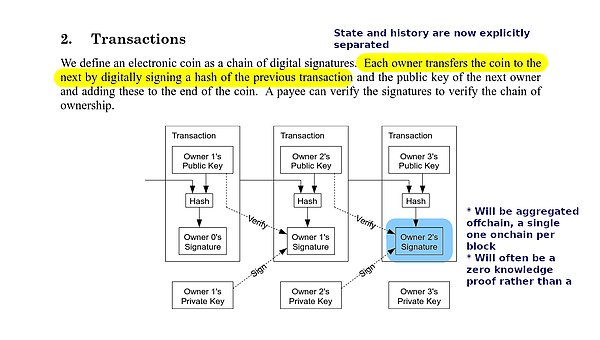
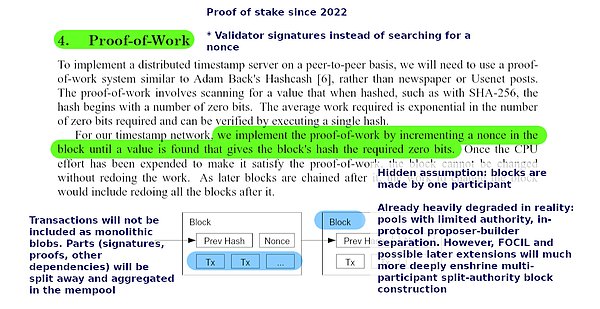
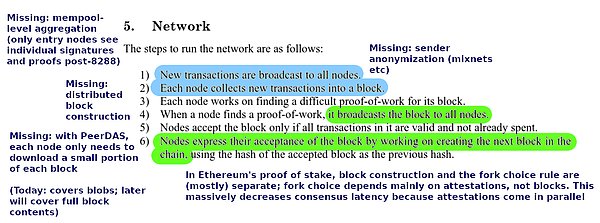
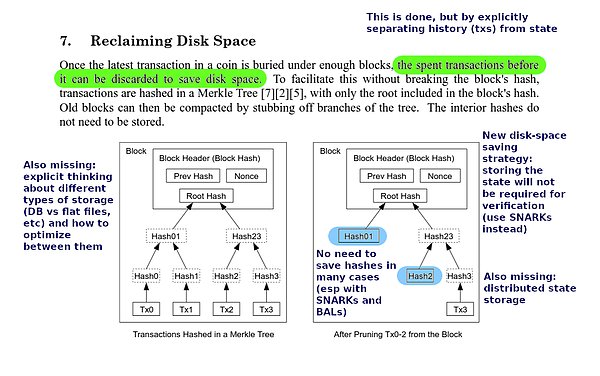
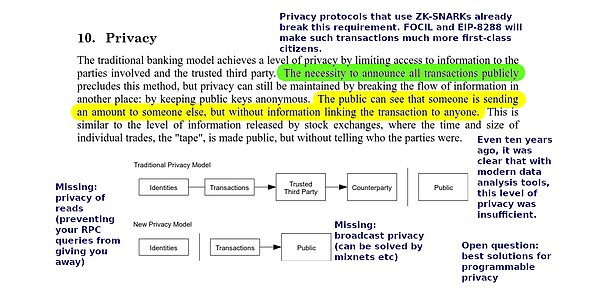
Basically, every section changes dramatically. To be more compact, let's make it a table:
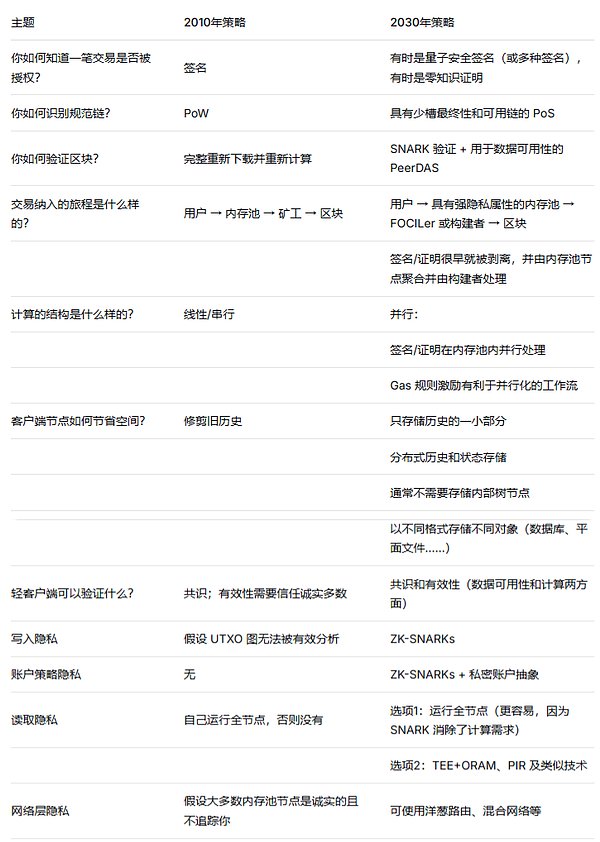
Almost every single thing that is the core attribute of a blockchain has either changed fundamentally or will change radically soon:
Validation: Download and re-execut ⁇ PerDAS sampling and validation of SNArk
Consensus: PoW ⁇ POS ⁇ Largely Optimized POS
Construction of blocks: single miners building blocks – multi-block construction
As AI might say, the only honest conclusion (well, honest point of view) is that modern encryption networks like Lean's upgraded Etherfrog are largely known for historical reasons as “block chains.” In fact, it is a hybrid structure that combines two threads:
The core idea of the middle mind.
New and powerful encryption mechanisms from 50 years of academia that did not even exist in 2009 (or are not yet mature)
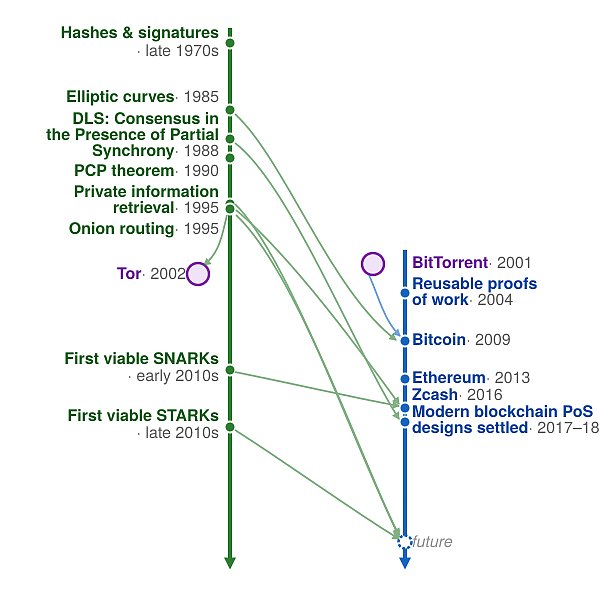 How many encryptions? Compared with 2009, 2020 and 2030.
Password is not the only science that matters. Equally important are formalization, database theory, improvement of point-to-point network theory, informatics, economics, etc.But all of this is compatible with the fundamental core of “everyone trying to create the next block with an effective POW, one person succeeds in broadcasting it, others download and re-execut it, repeat it.” And that's not true for code change.
So, what does that mean for users?
The most important conclusion is that the trade-off pool facing users is changing fundamentally:
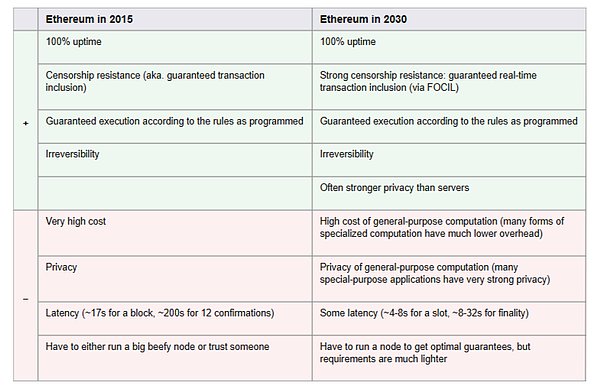 When building applications, the computational structure becomes very important. In a simple blockchain, 1 byte = 1 byte, 1 Gas = 1 gas. In the future architecture, the same amount of calculation would be much more costly if you inserted it all into an incomprehensible, collusive transaction; And if you put it in a good cover dependency that can be paralleled or trim, it would be much less expensive before the transaction even enters the final block. This will affect the incentives of developers and will influence over time the structure of all applications using the Etherwood: perhaps in the long run, we will be close to such a programming model — information directly related to descriptions of non-exchange changes and sequencing being posted on the chain, while all other elements are comprehensible before they are even incorporated into blocks.
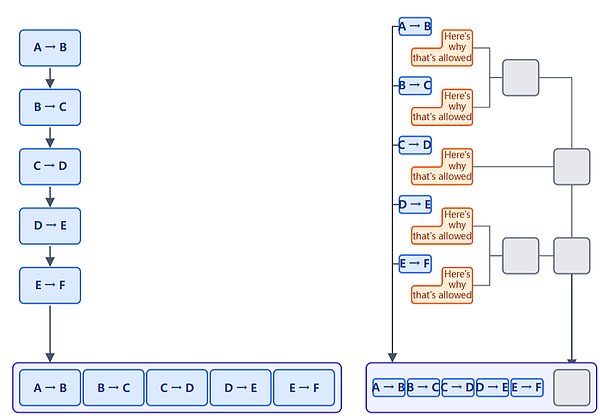 Structured calculations allow the blockchain to focus more effectively on its work.
Perhaps the most important shift is that the decentrization of networks is shifting from a purely secure and robust burden to at least some limited, or even performance-based, advantage. Decentrization allows for larger data to be stored in parallel. It allows large numbers of simultaneous calculations, in many cases within memory pools. In a few cases, it increases privacy because only decentrized networks can effectively hide metadata (e.g. where data and requests come from).
As early as the mid-2010s, this was an early dream of the Ethera: we could not only be de-centralized for soundness but also for scale. If the centralization system can be broken down between different participants to improve performance, then we can. At that time, one of the main reasons why this was not feasible was that the missing element was certification. If you split the job, you have to verify that each work unit is done correctly. Early design attempts to fix this with randomly sampled committees, but they all encounter the same bottleneck: first, the Commission is complex and costly and has significantly increased delays; Secondly, if the Committee failed, there would be no remedy. The problem had now been resolved through modern cryptography, and the cost factor for that solution was decreasing monthly.
Another area of concern is that de-centreization may improve the performance of delays. The ETA itself will never have a delay in competing with servers, but the infrastructure around it may be possible.
In general, creating a stronger decentrized layer between users and chains that is not a chain in itself can make the Etherpo very powerful without compromising any of the fundamental attributes of the chain.
Later in the future, the Ether Workshop may undergo another transformation - a possible rise of confusion. Here, the Grail is that a possible confusion can eliminate the trade-off between privacy and generalization: you can have complete generic calculations involving an unlimited number of participants (in hindsight) and do so in completely secure and encrypted form. Even the confusion of weak versions has many applications, such as encryption memory pools. However, all conclusions in this paper will apply well before they are available.
This is the "cipher world computer":From being a book where you can dump and execute the calculations and data indiscriminately, the Ether Workshop has been transformed into a structure that combines block chains with password privacy and authentication and powerful decentrized sub-components.
There are still many challenges in fully constructing this design. It is difficult to get zero knowledge to prove sufficiently efficient and safe, but it is a complex encapsulation and is already being significantly optimized with the help of AI tools. The more difficult and systematic part is likely to be management and parallelization of visits to very large numbers of states. There are many ideas about how to deal with this, but they need to be refined, especially as we learn better what applications will run in the future.
If you look at Strawmap,Hegota — the branch fork planned for next year — is likely to be the last “normal” fork in the Taifeng.Its functions and techniques are identifiable for people in 2015.Everything that has since happened has involved the regression of STARK, automated formalization certification, highly optimized consensus algorithms and the security of all its quantum.Through PeerDAS, the Ether Workshop began a shift from just a chain of blocks to something stronger. From Hegota, it turned into the main story of the Ether Workshop.
Final result: a high-security calculation that is cheaper, more expansive and more private than anything that can be done with just one generation of technology.
Password world computer.

 1

Declaration: This is a gold original, the copyright is a gold one and cannot be reproduced without authorization. A copy of this article must be downloaded from an agreed-upon medium with the indication "Source: Gold Book", for which the offender will be held liable under the law.
This information is not a financial investment proposal.
 Save



- Pantera's latest status report on monetization.
- What game is AAVE playing next?
- US SEC issues an update of the crypto asset FAQ to add a new issuer's currency buyback definition
- QNT surged over 300% a week, currency deposits infiltrated the core of the United States banking system?
- Vitalik's latest post: The Ether Workshop will become a password-based world computer.
24-hour text


 After $387.5 million was stolen, Bitget and thorchain got in a fight.
Conflux Tree Map blockchain

 How did the harvest line at the Meme Factory come out of the water, Robinwood Chain?
Chain catcher ChainCatcher
 Bitcoin goes into shock and waits for a new catalyst?
Knight of the Zone Chain.


 US SEC Committee member: Is the more regulatory data collection the better?
Asia-Pacific Future Study
- Seeking coverage
- Jinse Finance AppiOS & Android
- Community
Telegram - Feedback
- Back to Top
- Back to Bottom